The Middle Manager Problem: Why Lean Transformations Stall Between the Boardroom and the Shopfloor
- By Brett Griffiths
- Lean Technology
- Share
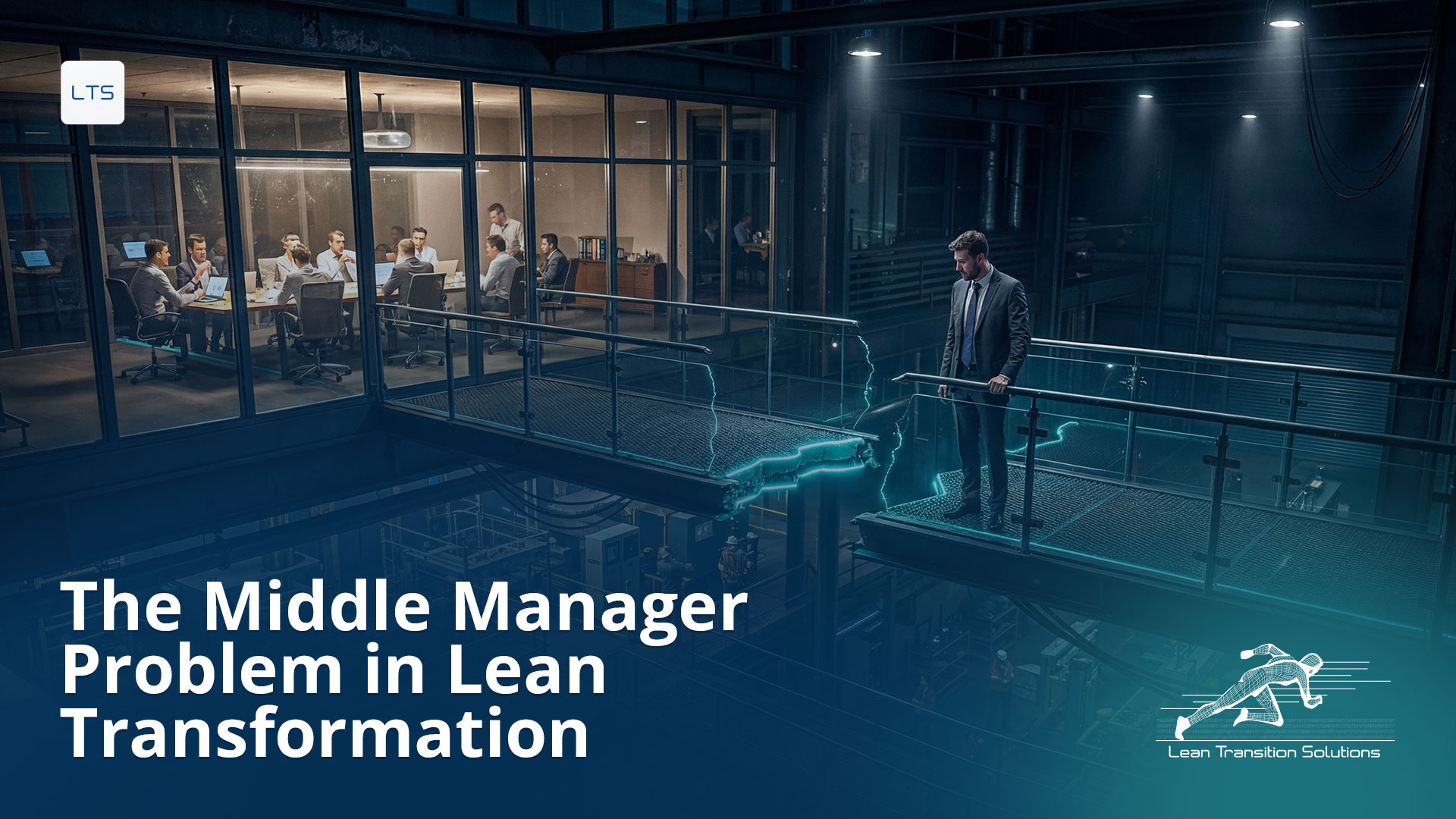
Lean transformation is often treated as a leadership challenge at the top and a culture challenge at the bottom. But recent studies tell a different story. The real breaking point stays in the middle.
Nearly three in four senior executives now report feeling stretched beyond their abilities. The reason? The middle manager problem – removal of the layer that once carried their strategy downward.
And the consequence? The lean flow disrupts. The shopfloor runs on old methods. The KPIs go unmet.
Both strategy and execution run in parallel, but they never meet. The targets are set at the top. Problems are visible at the bottom. And the gap between them widens quietly, year after year.
What you’ll learn in this blog
- Why lean strategies lose momentum before they reach the shopfloor and why this is a structural failure, not a communication one
- What middle managers are actually being asked to do on both sides of the organisation, and why most are set up to fail before they start
- Why labelling middle managers as resistant misreads the problem entirely and what is actually driving the disengagement
- What organisations that close the boardroom-to-floor gap actually do differently and how treating middle managers as deployment mechanisms changes the outcome
Why lean strategies lose momentum before they reach the floor
In most cases, lean strategy does not fail because it is wrong. It might be because the organisation never installed the mechanism to carry it downward. The layer that was supposed to do it, was never set up to succeed.
Harvard Business Review reports that 67% of well-formulated strategies fail due to poor execution, not poor strategy.
Majority says that their strategy is not clearly translated into concrete actions. This often leads to a misalignment between intent and execution. This gap can be easily measured inside a manufacturing organisation. The targets exist. The awareness exists. But the translation does not.
Where lean organisations attempt to close that gap through strategy deployment, the mechanism itself often fails. This is where lean change management as a discipline becomes critical — not as a communication exercise, but as a structural one. Pushing goals downward without a clear structured two-way dialogue, produces a plan that looks perfect on paper. But this pushing down does not work in the floor. It fails there. This is because the teams that were never involved in pressure-testing the plan never develop ownership of it.
The result is a specific kind of operational frustration. Kaizen events run. Improvement boards fill up. KPIs stay flat. The activity is real, but the alignment is not.
The strategic alignment fails neither on top nor at the bottom. It is in the middle that it fails. The question that surfaces the real problem then becomes:
What is the middle layer actually being asked to carry?
What middle managers are actually being asked to do
Every middle manager is asked to have a dual role – handing down the strategic targets set without operational context and escalating the problems faced by the shopfloor. Their role further demands they translate vision into practice without full authority to shape either one.
Even when this looks like the description of a difficult job, in reality, it is the description of an impossible structural position. The expectation of taking up the accountability of an outcome that they did not have the authority to shape.
44% of middle managers identify organisational bureaucracy as the main cause of negative experiences in the role.
In lean transformation, this problem piles up. At a usual workplace, middle managers are often the last people to know about an initiative. They are then asked to implement it without giving any context or input about what is actually going on, with a workforce in hand, watching to see if this is real.
Even if these middle managers are willing to take up this impossible task, they might not have the capability to do so. This points to the lack of lean experts with competencies to drive and manage lean implementation. There is also a shortage of supervisory and managerial skills at the middle layer. This leaves people in the middle layer responsible for daily deployment without the capability or coaching structure to sustain it. Ironically, the layer that is most responsible for keeping lean alive between strategy sessions and shift changes is the least equipped to do so.
When this happens, the organisation does not perceive it as a structural failure but sees a middle manager who is resistant. This is a lean leadership failure as much as a structural one. This misreading is where the real problem begins.
The resistance assumption and why it misreads the problem
The most common explanation for stalled lean transformation is middle manager resistance. This resistance to change showed by the middle managers may not always be an attitude problem. It could be several others.
- Most often than not, resistance is just a symptom, not a root cause. This resistance could be driven by role overload and workplace anxiety. The organisation is supposed to build the conditions. The managers only respond to them. If the conditions are not supportive enough, resistance is bound to happen.
- Transformation from what their career was built on to how it should be according to lean principles not only gives them a great challenge, but it also questions their identity. Organisations who ignore this issue keeps getting the same result.
- Being the ones under-supported and under-informed, these middle managers, who are responsible for carrying out this transformation becomes the ones who gets burnt out quicker.
Diagnosing a structural failure as a people problem is not just inaccurate. It is expensive. Every lean initiative that stalls at the middle layer while leadership looks for the wrong cause is another quarter of improvement activity that produces nothing. The question becomes:
What does the organisations that have stopped asking that question actually do differently?
Closing the gap: What organisations that get this right actually do
Organisations that bridge this gap between boardroom and shopfloor do something very different. They stopped treating the middle managers as relay and began treating that layer as a deployment mechanism itself.
- Using a Hoshin Kanri as a strategic alignment tool to connect strategic goals of the top with the plans of the middle management and the daily work at the shopfloor, middle management layer becomes an active deployment layer. They ensure that the goals and KPIs travel downward and results return upward. This is what shop floor leadership actually looks like when the structure supports it.
- Limiting tools like leader standard work, Gemba walks, and visual management to the shopfloor will further break the flow. They can be used by middle managers to get a daily operating rhythm for the first time. Without that rhythm, the gap reopens.
- What completes the picture is the leadership answer. The shift does not start with the middle managers. It begins with how the senior leadership defines the role, and whether they’re willing to give it the mandate and support the argument requires.
None of this is complicated in principle. The difficulty is that is asks organisations to fix the structure rather than the person and that is a harder conversation to start.
The middle manager problem is not a people problem. It has always been a structural one. Organisations that close the gap between boardroom and shopfloor do not find better middle managers, they build better conditions for the ones they already have. Fix the structure. Define the role. Give it the mandate. The transformation follows. That is operational excellence strategy applied where it matters most — not at the boardroom level, but at the layer that connects it to the floor. And when that layer finally works, what grows on the other side of it is lean culture.
FAQs
1. Does the middle manager problem exist in all manufacturing organisations or only large ones?
The structural gap between strategy and shopfloor is not a size problem, it is a design problem. Small and mid-sized manufacturers experience it as acutely as large ones, often more so, because middle managers in leaner organisations carry a broader span of responsibility with even fewer support structures around them.
2. How does senior leadership behaviour directly affect middle manager performance in lean?
When senior leaders bypass the middle layer, going directly to the shopfloor for updates, overriding decisions, or communicating strategy without involving middle managers, they unintentionally signal that the layer is decorative rather than functional. This erodes the middle manager's authority and accelerates the disengagement the organisation is trying to prevent.
3. Can lean transformation succeed without addressing the middle manager layer specifically?
Rarely and not sustainably. Organisations can generate short-term improvement results through top-down lean events and tool deployment. But without the middle layer carrying lean into daily operations, those results degrade as soon as attention moves elsewhere. Sustained lean transformation requires the middle layer to own it, not just participate in it.
4. What role does psychological safety play in closing the boardroom-to-floor gap?
Middle managers will only surface operational problems upward if they believe doing so is safe. In organisations where problems are met with blame rather than problem-solving, middle managers learn quickly to filter information before it reaches senior leadership, which means the boardroom is making strategy decisions on incomplete data, and the gap widens from both ends simultaneously.
5. How long does it typically take to close the middle manager gap in a lean transformation?
There is no fixed timeline, but organisations that address the structural conditions — role clarity, strategy deployment, daily management systems, and coaching — typically begin seeing measurable improvement in alignment within six to twelve months. Organisations that focus on tool deployment without addressing the middle layer often see initial gains reverse within the same period.



LEAN TRANSITION SOLUTIONS
The Old Vicarage, Pershore Road, Upton Snodsbury, Worcester, Worcestershire, WR7 4NR, United Kingdom.

Lean Manufacturing Software